


Key Takeaways
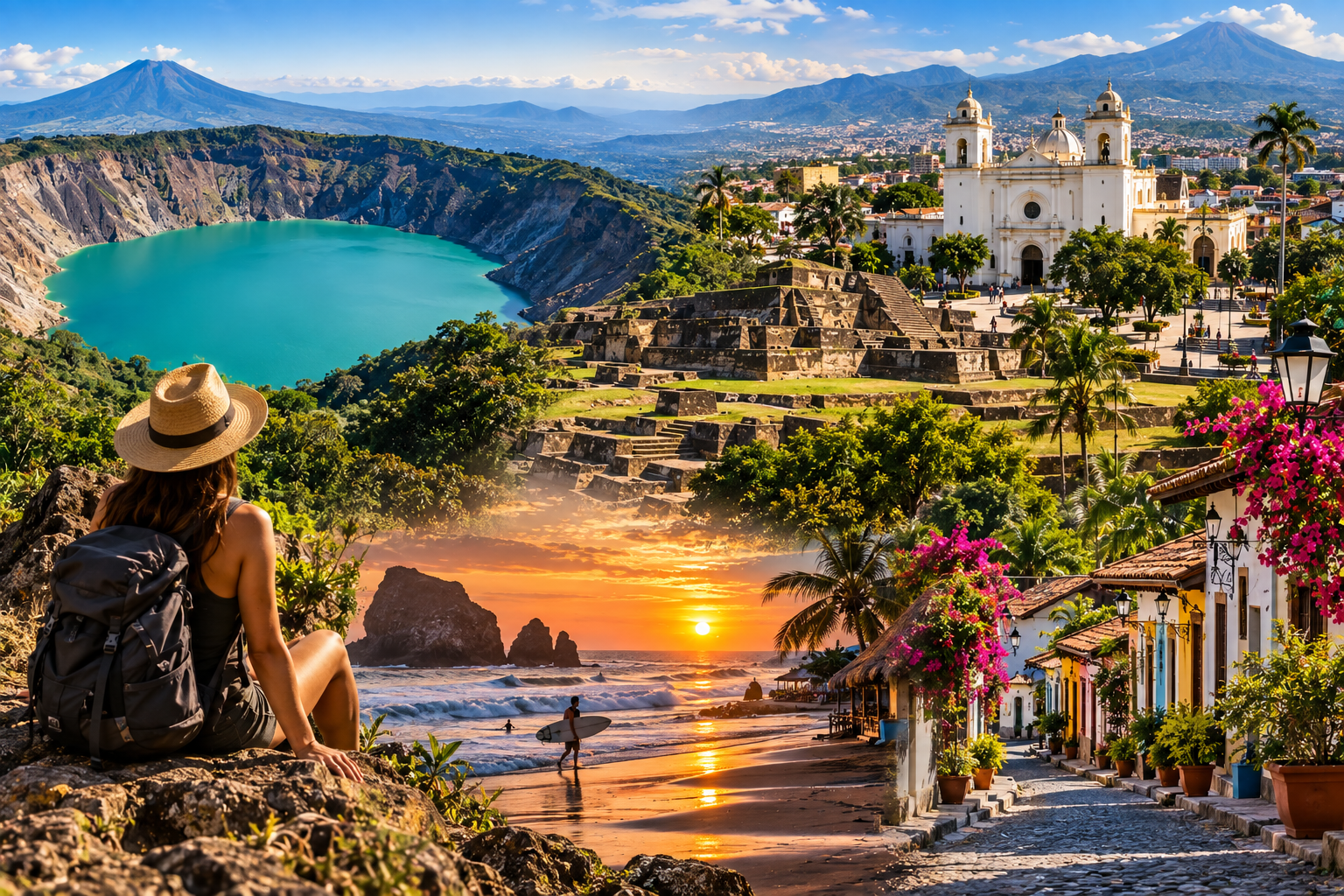
- El Salvador tourism combines volcanoes, Pacific surf beaches, Maya archaeological sites, colonial towns and coffee culture in Central America’s smallest country.
- Top places to visit: San Salvador, Santa Ana, Suchitoto, the Ruta de las Flores, Joya de Cerén, Lake Coatepeque and El Tunco.
- Five days is enough for a good introduction; 6 to 7 days lets you add beaches and volcano hikes at a relaxed pace.
- The dry season is best for hiking and sightseeing, while the rainy season brings greener landscapes and short afternoon showers.
- Private transport or guided El Salvador tours make it easy to combine several regions without changing hotels every night.
El Salvador tourism offers travelers an exciting combination of volcanoes, Pacific beaches, ancient archaeological sites, colorful towns, coffee plantations, local traditions, and vibrant urban life. Although El Salvador is the smallest country in Central America, its compact size makes it possible to experience an impressive variety of landscapes and activities during a relatively short trip.
Located between Guatemala and Honduras on the Pacific coast, El Salvador is a destination where mountains, volcanoes, tropical forests, and beaches can be reached within a few hours of each other. This makes the country particularly attractive to travelers who want to combine adventure, culture, history, and relaxation without spending most of their vacation on long journeys.
For many visitors, the biggest surprise is the diversity of experiences available in such a small territory. You can hike a volcano in the morning, explore an archaeological site in the afternoon, and watch the sunset over the Pacific Ocean later the same day.
Table of Contents
Why El Salvador Tourism Is Becoming More Interesting to Travelers
El Salvador tourism has gained attention among travelers looking for destinations that offer something different from the region’s more established tourist markets.
The country has traditionally been less visited than neighboring Guatemala, Costa Rica, and Belize. That gives travelers the opportunity to discover destinations where local culture and everyday life remain an important part of the experience.
One of the country’s greatest advantages is its geography.
El Salvador is compact enough to explore several major attractions without spending days traveling between them. San Salvador can serve as a convenient base for excursions to volcanoes, archaeological sites, lakes, colonial towns, and the Pacific coast.
The country’s volcanic landscape is another major attraction. More than one destination provides dramatic views of mountains, crater lakes, and volcanic terrain.
At the same time, the Pacific coastline offers black-sand beaches and internationally recognized surfing destinations.
For travelers interested in history, El Salvador also has an important pre-Columbian heritage. Archaeological sites such as Joya de Cerén, San Andrés, and Tazumal provide opportunities to learn about ancient civilizations that inhabited the region.
This combination of nature, history, and culture makes the country suitable for many different types of travelers.
El Salvador Tourism and the Best Places to Visit
A successful trip begins with choosing the destinations that best match your interests.
Some travelers want volcanoes and hiking, while others prefer beaches, colonial architecture, archaeology, food, or coffee.
The advantage of traveling through El Salvador is that you do not necessarily have to choose just one category.
San Salvador
San Salvador is the natural starting point for many international visitors.
The capital combines modern neighborhoods with historic areas, museums, monuments, restaurants, markets, and cultural attractions.
The historic center is particularly interesting for travelers who want to understand the country’s urban heritage.
Among the landmarks worth exploring are the Metropolitan Cathedral, National Palace, National Theater, and Iglesia El Rosario.
Plaza Salvador del Mundo is another recognizable landmark and an important meeting point in the capital.
San Salvador can also be used as a base for day trips.
From the capital, travelers can reach several major attractions, including volcanoes, archaeological sites, Lake Coatepeque, Suchitoto, and coastal destinations.
For first-time visitors, spending at least some time in the capital provides useful context before exploring the rest of the country.
Santa Ana
Santa Ana is one of the most attractive cities in western El Salvador.
The city is known for its historic center and impressive architecture, particularly the monumental Santa Ana Cathedral.
Its central area provides opportunities to walk around the main square, admire historic buildings, and experience local urban life.
Santa Ana is also strategically located for travelers interested in volcanic landscapes and archaeological attractions.
The city can be combined with visits to Santa Ana Volcano, Cerro Verde National Park, Lake Coatepeque, and Tazumal.
This makes Santa Ana an excellent destination for travelers who want to combine culture and outdoor activities.
Suchitoto
Suchitoto is one of the country’s most charming historic towns.
Its cobblestone streets, colorful buildings, artisan stores, traditional architecture, and relaxed atmosphere create a very different experience from San Salvador.
The central plaza is dominated by the historic Santa Lucía Church.
Walking around Suchitoto is one of the simplest ways to experience a slower side of Salvadoran life.
The town is also known for its cultural activities and local crafts.
Visitors can explore artisan workshops, discover traditional techniques, and enjoy restaurants and cafés around the historic center.
Suchitoto is especially attractive for travelers who prefer cultural experiences rather than large resort destinations.
El Salvador Tourism and the Ruta de las Flores
The Ruta de las Flores is one of the most popular scenic routes in western El Salvador.
The route connects several mountain communities, including Nahuizalco, Salcoatitán, Juayúa, Apaneca, and Ataco.
Each town has its own personality.
Nahuizalco is associated with indigenous traditions and handicrafts.
Salcoatitán offers a peaceful mountain atmosphere.
Juayúa is well known for its food culture and weekend atmosphere.
Apaneca sits in a cooler highland environment surrounded by coffee-growing landscapes.
Ataco is particularly popular with visitors because of its colorful streets, murals, cafés, artisan shops, and mountain scenery.
The route is ideal for travelers who want to slow down and discover local communities rather than simply visit major landmarks.
Coffee is another important part of the experience.
El Salvador has a long coffee-growing tradition, and the highlands around the Ruta de las Flores provide an opportunity to discover how coffee is cultivated, processed, roasted, and prepared.
A coffee tour can therefore become more than a tasting experience. It can introduce visitors to an important part of the country’s agricultural and cultural identity.
Ataco and Salvadoran Coffee Culture
Ataco deserves special attention for travelers interested in coffee and local traditions.
The town’s mountain setting provides a pleasant contrast to the warmer coastal areas.
Visitors can explore cafés, artisan stores, murals, and small streets while learning about local culture.
Coffee experiences in the region can include visits to plantations, explanations of cultivation techniques, tastings, and demonstrations of traditional processing methods.
For coffee enthusiasts, combining Ataco with other Ruta de las Flores destinations creates a rewarding day or multi-day experience.
El Salvador Tourism and Ancient Maya Heritage
The archaeological heritage of El Salvador is one of the country’s most fascinating attractions.
The region was home to complex societies long before the arrival of Europeans.
Today, several archaeological sites allow visitors to explore this history through monumental structures, settlements, museums, and preserved remains.
Joya de Cerén
Joya de Cerén is one of the most unusual archaeological sites in Central America.
The ancient settlement was buried by volcanic ash, which helped preserve structures and evidence of everyday life.
Unlike archaeological sites that mainly showcase temples or monumental architecture, Joya de Cerén provides insight into ordinary community life.
Visitors can see remains associated with homes, agricultural activities, and other aspects of daily life.
The site is recognized as a UNESCO World Heritage Site because of its exceptional archaeological importance.
For travelers interested in history, Joya de Cerén is an essential stop.
San Andrés Archaeological Park
San Andrés was an important ancient settlement and ceremonial center.
The archaeological park contains monumental structures and provides visitors with an opportunity to understand more about the political, religious, and social organization of ancient communities in the region.
A museum complements the archaeological experience.
Visiting San Andrés together with Joya de Cerén creates a more complete understanding of the region’s ancient heritage because the two sites provide different perspectives on pre-Columbian life.
Tazumal
Tazumal is another major archaeological destination.
Located near Chalchuapa, the complex contains monumental structures associated with ancient civilizations that developed in the region.
The site is particularly interesting for travelers fascinated by ancient architecture and archaeology.
A visit to Tazumal can easily be combined with Santa Ana and other western El Salvador attractions.
El Salvador Tourism and Santa Ana Volcano
Volcanoes are one of the defining features of the country.
Santa Ana Volcano, also known as Ilamatepec, is one of the most spectacular volcanic destinations in El Salvador.
The hike takes visitors through a changing landscape before reaching the summit area.
The reward is a remarkable view into the volcano’s crater, where a striking crater lake creates one of the country’s most memorable natural scenes.
The surrounding landscape includes views toward Lake Coatepeque and Izalco Volcano.
The experience is particularly appealing to travelers who enjoy hiking, photography, nature, and adventure.
Because the hike involves elevation and uneven terrain, visitors should prepare appropriately.
Good hiking shoes, sufficient drinking water, sun protection, and comfortable clothing are recommended.
Weather conditions can also change quickly in mountainous environments, so travelers should be prepared for different conditions.
Cerro Verde National Park
Cerro Verde National Park is another important destination for nature lovers.
The park is surrounded by volcanic landscapes and offers views toward several major natural landmarks.
Its vegetation also provides habitat for different species of birds and other wildlife.
The park can be incorporated into a broader volcano itinerary that includes Santa Ana Volcano and Lake Coatepeque.
For travelers who want to experience El Salvador’s natural environment without spending their entire vacation hiking, Cerro Verde offers a good balance between scenery, nature, and accessibility.
El Salvador Tourism and Lake Coatepeque
Lake Coatepeque is one of the country’s most impressive natural attractions.
The lake occupies a volcanic caldera and is surrounded by mountains and vegetation.
Its dramatic setting makes it particularly popular with photographers and travelers looking for scenic landscapes.
Visitors can enjoy views of the lake from different points around the surrounding area.
Depending on the season and local conditions, activities around the lake can include water-based recreation, restaurants, relaxation, and sightseeing.
Lake Coatepeque is also conveniently combined with Santa Ana Volcano and Cerro Verde.
This makes the lake an excellent addition to a western El Salvador itinerary.
El Salvador Tourism and the Pacific Coast
The Pacific coast provides another completely different side of the country.
El Salvador’s coastline is characterized by volcanic black-sand beaches, rocky formations, tropical vegetation, and internationally recognized surf breaks.
Among the best-known coastal destinations is El Tunco.
El Tunco
El Tunco has become one of El Salvador’s most recognizable beach destinations.
The town is famous for surfing and has developed a lively international atmosphere.
Travelers can find restaurants, cafés, surf schools, accommodation, and places to relax near the beach.
The volcanic coastline gives El Tunco a distinctive appearance.
The beach is particularly attractive around sunset, when the Pacific horizon and coastal rock formations create impressive views.
Travelers who are not interested in surfing can still enjoy the destination.
You can walk along the coast, relax, enjoy local food, take photographs, or explore nearby beaches.
For surfers, however, the area provides access to some of the country’s best-known surf breaks.
Surf City El Salvador
Surf City has become an important part of the country’s coastal tourism identity.
The area includes several beaches and coastal communities where visitors can experience surfing, beach life, restaurants, and outdoor activities.
Travelers interested in learning to surf can find opportunities for surf lessons and equipment rental in established surf destinations.
More experienced surfers may be interested in exploring different breaks along the coastline.
Even visitors who do not surf can enjoy the relaxed atmosphere and scenic Pacific coastline.
El Salvador Tourism for Adventure Travelers
Adventure is one of the strongest reasons to explore the country.
Volcano hiking, surfing, mountain excursions, waterfalls, outdoor activities, and scenic road trips can all be incorporated into an itinerary.
Santa Ana Volcano is the obvious choice for hikers.
The Pacific coast is ideal for travelers interested in surfing.
The Ruta de las Flores offers mountain scenery and outdoor exploration.
Waterfalls and natural attractions around the western region provide additional options for travelers who want to spend time outdoors.
Because distances between destinations are relatively manageable, it is possible to create an itinerary that combines several adventure activities without constantly changing hotels.
El Salvador Tourism for History and Culture Lovers
Travelers interested in history can build an entire vacation around cultural attractions.
San Salvador provides an introduction to modern Salvadoran history and architecture.
Suchitoto offers colonial heritage and local traditions.
The archaeological sites provide access to much older history.
The Ruta de las Flores introduces visitors to mountain communities, crafts, food, and coffee traditions.
This mixture is one of the country’s strongest cultural assets.
Rather than presenting history as something limited to museums, the country allows visitors to experience it through architecture, archaeological sites, traditional crafts, food, and local communities.
El Salvador Tourism and Salvadoran Food
Food is an important part of discovering any destination, and El Salvador is no exception.
One of the country’s best-known foods is the pupusa.
Pupusas are traditional stuffed flatbreads and are commonly enjoyed with curtido and tomato sauce.
Different fillings can be used, making them an easy introduction to Salvadoran cuisine.
Travelers can also discover soups, grilled meats, seafood, tropical fruits, coffee, and other local specialties.
Food markets and small local restaurants can provide experiences that are very different from international tourist establishments.
For visitors interested in culinary travel, combining food experiences with the Ruta de las Flores, Suchitoto, or San Salvador can add another dimension to the trip.
El Salvador Tourism: How Many Days Do You Need?
The ideal length of a trip depends on your interests.
A short three-day visit can focus on San Salvador and one or two nearby attractions.
A five-day itinerary provides significantly more possibilities.
Travelers can combine San Salvador, the Ruta de las Flores, archaeological sites, Santa Ana, and Suchitoto.
A six- or seven-day trip allows more time for hiking, beaches, and relaxation.
Longer trips provide an opportunity to explore the Pacific coast at a slower pace and include additional destinations.
The country’s compact geography makes short trips surprisingly productive.
However, trying to see everything in a few days can make the journey feel rushed.
A balanced itinerary is usually more enjoyable than attempting to visit every attraction.
El Salvador Tourism: Best Time to Visit
The country has a tropical climate, but conditions vary depending on elevation and season.
The dry season is generally associated with sunnier conditions and can be convenient for outdoor activities, sightseeing, and beach visits.
The rainy season can bring heavier showers, particularly in the afternoon, while also producing greener landscapes.
Travelers interested in hiking volcanoes should pay particular attention to weather forecasts and local conditions.
Coastal areas tend to be warmer, while mountain towns such as those along the Ruta de las Flores can feel cooler.
Choosing the best travel period therefore depends on your priorities.
Surfers, hikers, photographers, and cultural travelers may have different preferences.
El Salvador Tourism: Getting Around the Country
Transportation is an important consideration when planning a trip (our El Salvador travel guide has more practical tips).
Private transportation is particularly convenient for travelers who want to visit several destinations within a short period.
A private vehicle allows travelers to move between San Salvador, archaeological sites, mountain towns, volcanoes, and beaches according to a planned itinerary.
It can also make multi-destination trips easier for families and small groups.
Travelers who prefer independent travel can use a combination of buses, taxis, rental cars, and other local transportation options.
However, anyone planning to visit several attractions should consider travel times carefully.
An itinerary that looks short on a map can take longer because of road conditions, traffic, stops, and mountain roads.
El Salvador Tourism for Families
Families can find a wide variety of experiences in El Salvador.
Children and teenagers may enjoy volcanoes, beaches, archaeological sites, waterfalls, wildlife, and outdoor adventures.
Cultural visits can also be made more engaging by combining them with hands-on activities.
A coffee experience, artisan workshop, food tour, or traditional craft activity can provide an interactive alternative to conventional sightseeing.
Families may also appreciate private transportation because it provides greater flexibility throughout the journey.
Parents can organize sightseeing days around the family’s energy levels rather than following a rigid group schedule.
El Salvador Tourism for Couples
Couples can combine adventure with relaxation during a trip through the country.
A day hiking Santa Ana Volcano can be followed by an evening near Lake Coatepeque.
The colorful streets of Suchitoto offer a pleasant setting for walking and photography.
Ataco provides cafés, mountain scenery, and a relaxed atmosphere.
The Pacific coast is ideal for watching sunsets and enjoying beachside restaurants.
A private itinerary can also provide greater flexibility for couples who want to spend more time in places they enjoy.
El Salvador Tourism for Solo Travelers
Solo travelers can experience the country through cultural tours, organized excursions, hiking experiences, surf activities, and local food experiences.
Staying in popular tourist areas can make it easier to meet other travelers. Before you go, read our guide: is El Salvador safe for tourists?
El Tunco, for example, has an established international surf community.
Suchitoto and the Ruta de las Flores provide opportunities to interact with local businesses and artisans.
Solo travelers who prefer convenience can also choose guided day trips or private transportation for destinations that are difficult to reach independently.
El Salvador Tourism: Building the Perfect Itinerary
A good itinerary should balance different types of experiences.
Rather than scheduling several archaeological sites on consecutive days, consider combining history with nature and local culture.
For example, a traveler could begin with San Salvador, continue to the Ruta de las Flores, explore Tazumal and Joya de Cerén, visit Santa Ana Volcano, and finish on the Pacific coast.
Another option is to spend more time around San Salvador and take several day trips.
This approach can reduce the number of hotel changes.
Travelers with more time can extend their stay in Suchitoto, Ataco, or El Tunco.
The best itinerary depends on whether your priority is adventure, culture, archaeology, beaches, coffee, or a combination of all of them.
El Salvador Tourism: A Destination for Authentic Experiences
One of the most appealing aspects of traveling through El Salvador is the opportunity to experience the country beyond its major attractions.
Meet local artisans.
Taste Salvadoran coffee.
Explore traditional markets.
Walk through colonial streets.
Learn about ancient communities.
Watch surfers along the Pacific coast.
Hike through volcanic landscapes.
These experiences create a more complete picture of the country.
A destination becomes memorable not only because of its famous landmarks but also because of the people, traditions, food, landscapes, and small moments experienced along the way.
El Salvador Tourism: Frequently Asked Questions
Is El Salvador good for tourists?
El Salvador offers a wide variety of attractions for travelers, including archaeological sites, volcanoes, beaches, colonial towns, coffee experiences, and cultural activities. The country can be suitable for adventure travelers, families, couples, solo travelers, surfers, and history enthusiasts. Travelers should always check current official travel advice and local conditions before their trip.
What are the best things to do in El Salvador?
Popular experiences include hiking Santa Ana Volcano, visiting Joya de Cerén and Tazumal, exploring San Salvador, discovering Suchitoto, traveling along the Ruta de las Flores, experiencing Salvadoran coffee culture, visiting Lake Coatepeque, and relaxing or surfing around El Tunco.
Is five days enough to visit El Salvador?
Five days can provide a good introduction to the country. A carefully planned itinerary can combine San Salvador, the Ruta de las Flores, archaeological sites, Santa Ana, Suchitoto, and the Pacific coast. Travelers with more time can explore additional destinations at a slower pace.
What is El Salvador famous for?
El Salvador is known for its volcanoes, Pacific beaches, surfing, coffee, pupusas, archaeological heritage, colonial towns, and natural landscapes. Santa Ana Volcano, Lake Coatepeque, Joya de Cerén, Suchitoto, the Ruta de las Flores, and El Tunco are among the destinations frequently included in visitor itineraries.
Is El Salvador expensive for tourists?
Travel costs vary considerably depending on accommodation, transportation, restaurants, activities, and travel style. Independent travelers can create different budgets, while private tours and organized experiences generally provide greater convenience. It is useful to compare accommodation, transportation, and activity costs before planning a trip.
El Salvador Tourism: Final Travel Inspiration
El Salvador offers an unusually diverse travel experience within a compact country.
Travelers can explore the historic center of San Salvador, walk through the colonial streets of Suchitoto, discover ancient archaeological sites, visit coffee-growing mountain communities, hike a volcano, admire a crater lake, and finish the journey on a Pacific beach.
The country’s landscapes change quickly.
Urban streets give way to mountains.
Coffee plantations surround colorful towns.
Ancient archaeological sites sit within landscapes shaped by volcanoes.
The Pacific coastline provides a completely different atmosphere.
This diversity makes the country particularly interesting for travelers who do not want a conventional beach vacation or a purely cultural trip.
Instead, visitors can combine several travel styles into one journey.
For adventure travelers, volcanoes and surfing provide memorable outdoor experiences.
For history lovers, archaeological parks and colonial towns reveal different chapters of the country’s past.
For food and coffee enthusiasts, local traditions provide opportunities to taste and learn.
For families, private tours and flexible itineraries make it easier to combine sightseeing with relaxation.
For couples and solo travelers, the country’s compact geography allows several destinations to be connected during a relatively short trip.
Ultimately, the best way to discover the destination is to create an itinerary that combines its different personalities rather than focusing on only one attraction.
From the mountains of the Ruta de las Flores to the ancient structures of Tazumal, from the crater of Santa Ana Volcano to the black-sand beaches of El Tunco, El Salvador offers a remarkable concentration of experiences.
For travelers searching for a destination with culture, nature, adventure, history, coffee, and Pacific beaches, this small Central American country deserves a place on the travel map.
Plan Your El Salvador Adventure
Whether you are planning a short getaway or a longer Central American journey, building your itinerary around the country’s major regions can help you experience more while avoiding unnecessary travel.
Start in San Salvador to discover the capital.
Continue west toward Santa Ana and the Ruta de las Flores.
Explore Tazumal and Joya de Cerén to discover the country’s archaeological heritage.
Visit Suchitoto for colonial architecture and local traditions.
Add Santa Ana Volcano and Lake Coatepeque for spectacular natural scenery.
Then finish your journey on the Pacific coast, where El Tunco and the surrounding beaches provide the perfect opportunity to relax.
With the right itinerary — or one of our El Salvador tours — even a short visit can reveal the remarkable diversity of this destination.
El Salvador tourism is ultimately about discovering a country where ancient heritage, volcanic landscapes, coffee culture, colonial towns, and Pacific beaches come together in one compact and memorable travel experience.
[…] Salvador also has an important pre-Columbian heritage, charming colonial towns, coffee-growing regions, lively markets, beautiful beaches, and a growing […]
[…] Salvador has a fascinating archaeological heritage that is sometimes overlooked by international […]